Jack Ruthven's Adoption
Young Captain Jack · The Son of a SoldierJack Ruthven's Adoption is the event that transforms a nameless, shipwrecked child into a member of the Ruthven household. It saves Jack's life and gives him the legal and emotional standing of a son and brother, yet it also leaves the question of his birth unresolved. That double effect governs his later crisis: the family that raises him is real, while the history from which he came remains hidden behind a wreck, a dead mother, and a few damaged personal objects.
Rescue from the Hemlock Bluff Wreck
Jack's adoption begins with the wreck that came ashore on Hemlock Bluff rocks between ten and eleven years before the principal events of the story. Jack was then only three or four years old. Old Ben found him on the beach in the arms of his injured mother after hearing a cry of pain. The child had been exposed to the storm and nearly died, and Old Ben carried both survivors to the boathouse before going to the plantation for help. Jack's mother was taken to the Ruthven home with the assistance of Colonel Martin Ruthven and several men.
The rescue preserves Jack but cannot preserve his original family. His mother died two days later without recovering consciousness, despite the physicians' efforts. Her final words, as remembered by the Ruthvens, were a plea to save her husband and her little Jack. She supplied no surname, birthplace, or explanation of the voyage. Jack retained only a blurred recollection of the storm and the waves, a memory he described as dreamlike rather than a usable account of his past.
Adoption and the Making of a Family
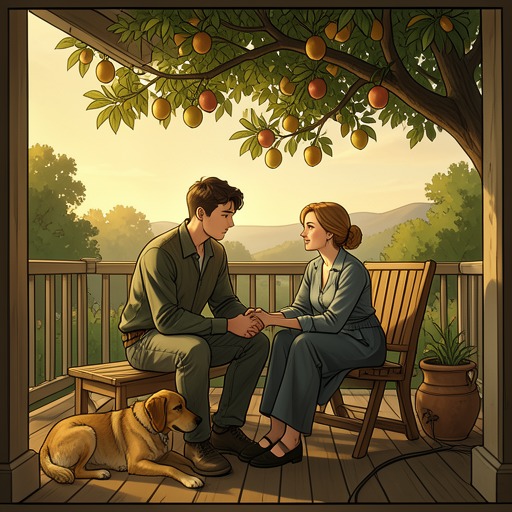
After his mother's death, Colonel Martin Ruthven and his wife adopted Jack. The adoption is not merely an act of shelter: Mrs. Ruthven later tells Jack that he has been a son to her and that she wants him to continue in that place. When Jack doubts that he has any real claim upon her, she answers that her late husband and she adopted him. Marion Ruthven likewise explains that, in the eyes of the law, he is her real brother because her parents adopted him.
The household therefore gives Jack two forms of belonging at once. He is legally part of the Ruthven family, and he is emotionally bound to the people who raised him. Mrs. Ruthven is a widow after Colonel Martin Ruthven's death at the Battle of Gettysburg, and Marion, seventeen years old when introduced, regards Jack as her brother and is described as inseparable from him. Their closeness makes the later revelation that Jack is not biologically a Ruthven painful, but it also demonstrates that the adoption has created a genuine family rather than a temporary arrangement.
The Missing Past and Its Material Traces
The Ruthvens make repeated efforts to identify Jack, but the circumstances of the voyage defeat them. Jack's parents had taken passage at the last moment, so their names were absent from the shipping-office lists. None of the ship's own books survived, and the only bodies recovered were those of sailors. The wreck was searched from end to end, but no information capable of identifying the child was found.
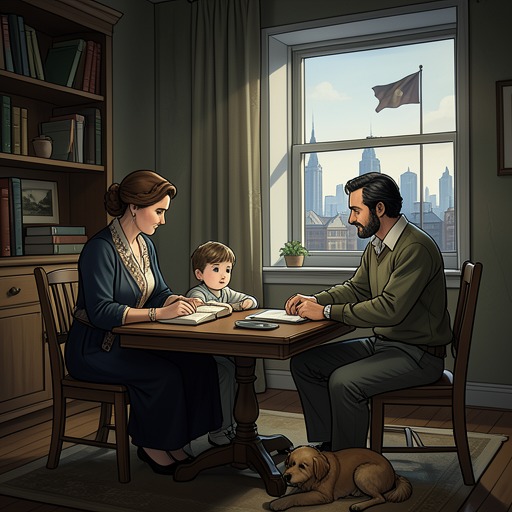
A few objects remain as incomplete evidence. Jack's clothing bears no mark, and his mother's pocket contains only an unmarked lace handkerchief. Mrs. Ruthven preserves the handkerchief and the clothing, along with a ring from the dead woman's finger. The ring once carried an inscription, but it has been worn so smooth that neither the Ruthvens nor two jewelers can read it. When Jack asks to see it, Mrs. Ruthven brings out a small jewel casket containing the ring and handkerchief. The ring looks to him like a wedding ring, linking the lost child to an absent marriage without revealing the family's name.
The wreck itself also remains an active source of possibility. Jack wonders whether the missing books or other proof may still lie aboard the vessel, even though the earlier search supposedly removed everything of value. Thus the adoption does not close the identity mystery; it gives the mystery a home from which Jack can investigate it.
From Adopted Son to Contested Son
The adoption becomes a source of anguish when St. John Ruthven tells Darcy Gilbert that Jack is a nobody who does not belong to the Ruthven family and will someday have to leave. Darcy reports this to Jack, and the accusation fills him with consternation. Jack briefly turns the social insult inward, whispering that he is indeed a nobody. Marion counters that he is not a nobody, that he was adopted when he was three or four, and that he is John Ruthven, her own brother.
The plot then places the legal fact of adoption beside competing biological claims. Dr. Mackey confronts Jack after their encounter on the bridge and declares that he is Jack's father. Later, however, Jack is told that he is not Dr. Mackey's son at all but the son of Colonel Stanton, a claim Colonel Stanton has proved beyond reasonable doubt. The successive versions of Jack's identity—Ruthven foster son, unidentified child of the wreck, alleged son of Dr. Mackey, and finally Colonel Stanton's son—make adoption the stable center amid unstable accounts of bloodline. The family that raised Jack is never erased by the later discovery of his parentage.
Consequences and Long-Term Significance
The adopted child develops into a self-reliant and courageous young man. He is not easily intimidated by those who try to browbeat him, and the confidence formed within the Ruthven household becomes practical responsibility during wartime. He organizes a Home Guard company of twenty-three boys and serves as its captain, equipped with an old sword and a pistol while the other members carry pistols or guns. Even when later held as a close prisoner in a small mountain cabin, with his hands bound behind him to a wooden stake and without food or drink, he remains the active subject of the larger identity and survival story rather than a passive victim.
Once Colonel Stanton's paternity is established, Jack's life continues to join inherited identity with chosen allegiance. Years later he enters West Point Military Academy, graduates with high honors, and goes West as an officer at a well-known fort. His daring and honorable career carries him to the rank of colonel, a position he fills with the bravery and loyalty associated with his youth. The adoption therefore has a lasting significance beyond the mystery of his birth: it is the first act that saves him, the family bond that defines his earliest loyalties, and the foundation from which he grows into an adult whose conduct proves that identity is sustained not by blood alone but by care, law, courage, and fidelity.